|
MUSKEGON, Mich. (March 18, 2026) – The Light Goose Conservation Order (LGCO) is considered an annual tradition for many waterfowl hunters since it began in 1999. There is no other waterfowl opportunity in North America offering such latitude when it comes to regulations: No magazine restrictions, no daily bag or possession limit, use of electronic callers is permitted, and you can shoot 30 minutes past sunset – all sacred no-no’s across the US during regular waterfowl seasons regulated by state and federal law enforcement.
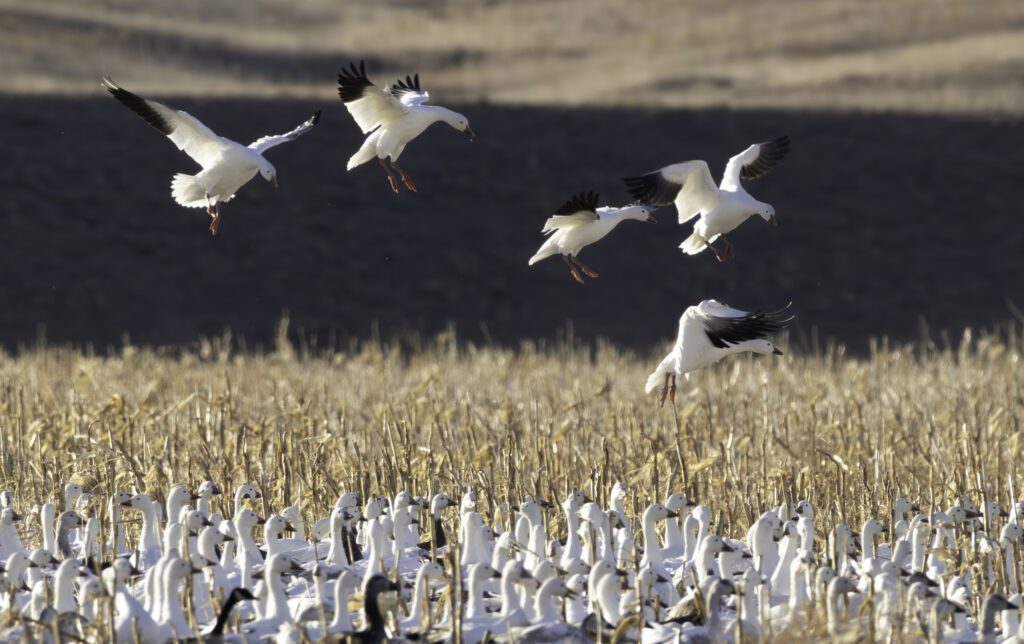
Besides the potential for high volume shoots, anybody who participates in this unique opportunity will tell you it’s the spectacle of the spring migration that keeps them coming back. On the best migration days hunters should expect to witness waves of various waterfowl and other bird species rolling past, but no other species of waterfowl surpasses the lesser snow goose in number and density during migration. It’s common to see hordes of snows and their smaller cousin, the ross goose.
“Generally, I book my hunts for South Dakota in the northern half of the state during late March thru mid-April,” said Borchelt. “I don’t run any guided hunts in North Dakota, but I do fun hunt up there mid to late April. How long we can run in South Dakota really depends on the weather and how eager light geese are to push north. Most years you can shoot snows in northern South Dakota into the last week of April, which I’ve done. But I’ve also chased them to the Canadian border as late as the first week of May.”
According Borchelt, hunting the Dakotas has advantages and disadvantages when it comes to spring snows. “One advantage is typically hunting pressure is a little more spaced out, and this is likely due to the fact there is a lot more water to roost on with the pothole region being right there. However, South Dakota’s ever-changing weather presents challenges. Also, since it’s further north these birds have been chased all the way from the southern end of the flyway to the top and they’ve seen every spread and heard every e-caller. You must be extremely well hidden, and, ideally, try to find tactics that are unique in some ways to look and sound different.”
The debate on windsock vs full body has raged on for decades and there are some hunters who will swear by one or the other. The truth is both have their days. That said, full bodies are far more realistic and often require fewer decoys to do the job, plus they are far more durable and capable of handling permanent spread status with zero regard for the near guaranteed inclement weather associated with hunting snow geese during the LGCO.
The biggest issues associated with full body decoys is transporting them due to their size, but there is a great option for hunters concerned about the prospect of investing in a larger decoy trailer to store a full body spread – Borchelt is sold on one brand full body for several reasons: Hardcore.
“Hardcore full body snow goose decoys are very close to actual life size, while other decoys companies are trying to make them bigger for visibility,” he explained. “Frankly, larger decoys hurt you on the versatility side, whereas you can pack a lot more Hardcores due to their realistic size, and their weight is significantly less than compared to other brands. We regularly fit 1,000 or more Hardcore full bodies in a smaller trailer, and you simply cannot do that with any other brand of decoy. Socks may be the most condensable decoy, but if you want durability and realism, not to mention much better motion and a fair price, then Hardcore is what I’d choose.”
Snow geese are notorious for their propensity to travel and feed in huge concentrations. Subsequently, decoy spreads are notoriously big, and in some cases bordering on ridiculously enormous. “The number of decoys is extremely situational,” said Borchelt. “Hunting feeds vs. traffic or migrators – juvies vs adults? Personally, I want all the tools in my arsenal to be able to handle varying situations. Generally, I’ll go with 1,200+ for migrator rigs and about 400 or 500 for feed chasing. Typically, I’m not chasing feeds unless it’s a larger concentration of juvies, so I’m usually dealing with a big spread of full bodies.”
One of the most unique aspects of the LGCO is the legal use of electronic calls. Adult snow geese are notoriously difficult to finish and the ability to employ professionally recorded snow goose vocalizations via e-callers is often a huge advantage for hunters. E-callers are especially useful for hailing sky high migrant flocks down. However, snow geese have grown increasingly wise to the e-caller with many hunters using the same call tracks day after day, season after season. And snow geese seem to retain knowledge better than other species of waterfowl as well.
“These birds have heard it all by the time they get as far north as the Dakotas and it’s important to keep this in mind,” added Borchelt. “I’ll use less sound when hunting feeds because they are already coming there, but when hunting migrators, I’ll run 6 or 8 e-callers and multiple tracks and run them super loud, so it reaches them way up there. Lots of sound!”
Many waterfowl hunters may be over it by the time snow geese hit the Dakotas during their spring migration, but this may be the best opportunity of the Conservation Order to hunt big concentrations of snow geese with less competition from hunters. There are turkeys to be hunted soon, and fishing may be picking up fast, but a grand finale spring snow goose hunt in the Dakotas is well worth the effort.
|